
1
We position the joint at its restriction.
This one you do yourself. You push gently against a steady hand, in a direction we set up, and the joint moves back toward where it should have been sitting.
What It Is
Muscle Energy Techniques, or MET, flip the usual arrangement. Instead of your therapist moving you, you contract against their resistance, gently, in one precise direction they have set up for you.
That contraction is doing real work. It uses your own muscle to reposition a joint that has drifted, and it changes the tone of the muscle that was holding it there. Most of it happens at the pelvis, the ribs and the spine, where a small alignment problem quietly rewrites how everything above and below it moves.
You have already read up on your own hip. You know what a sacroiliac joint is. That is exactly the person who does well with a technique that needs your participation, because you can feel what changed and you leave able to repeat it. And that is the point: the correction opens a window, and the strength work inside that window is what stops the pelvis drifting back.
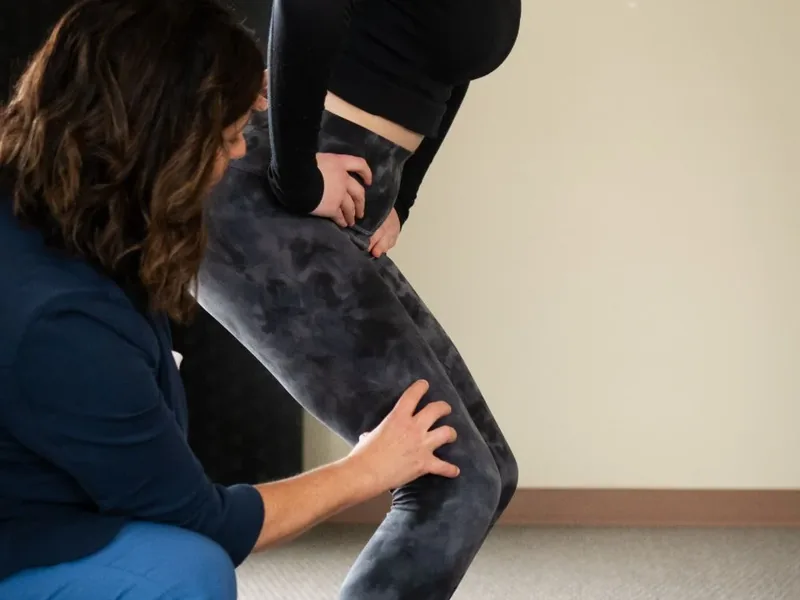 Active: the force comes from you
What It Helps
An alignment problem never stays local. The hip that sits high changes your stride, your stride changes your back, and the list of things that hurt gets longer the longer you wait it out.
What A Session Looks Like
1
We position the joint at its restriction.
2
You push gently against a steady hand.
3
We retest, then hand you the exercise.
Why It Works
No cracking and no forced movement.
Restores motion at pelvis, ribs and spine.
You feel the change while it happens.
Translates straight into your home exercise.
Pairs Well With
Questions, Answered
Push gently, and hold. Your therapist positions the joint right at the edge of its restriction and asks for a light contraction in one direction against their hand. You hold, relax, and they take up the new slack. It is closer to a guided isometric than to a stretch, and it never asks for full effort.
No. MET does not use a thrust. The force comes from your own muscle and stops the second you stop, so nothing gets pushed past where you allow it to go. You might hear a small release as tissue lets go, and that is neither the goal nor the measure of whether it worked. If joint manipulation would serve you better, your therapist will say so and explain it before anything happens.
It depends on your plan. MET is one technique your therapist may use inside a physical therapy visit, and plans cover those visits differently. We will check your benefits for you before you start, and you will hear the real answer rather than a maybe. Call us at (319) 382-2743 with questions.
Book Your Visit
Request a time and a real person calls you back. No phone tree. No ‘someone will reach out.’ Just a plan.
4.9 · 79 Google reviews
Typical response: under 2 business hours
Step 1 of 5
That’s the hard part done. We’ll call during business hours to lock in your time.
Visit Us