
Spotlight Series
Spotlight Series topic: Ketamine for Depression
Guest Name: Beth Westermann
Guest Credentials: DNP, CRNA, ARNP (she/her)
Discussion Details:
In this video Beth tells us about the evidence based use of Ketamine for depression. She discusses the safety and efficacy of Ketamine use, eligibility requirements, and promising outcomes.
Benefit of Watching:
This video provides information about a novel and promising intervention for depression. Whether you suffer from depression or have a friend or family member that suffers from depression, this video will provide you with useful information to consider.
Address of guest’s business:
North Liberty Location
1740 Lininger Ln North Liberty, IA 52317
Natalie Johnston: All right, I have Beth Westerman with us today and um we are hoping to bring Beth back for a conversation here at Motion Matters Physical Therapy and Wellness um in a little bit and I wanted to just get a little recording um because I think she has so much to offer um so much information to offer our community here and I want to be able to be part of helping get the word out for what you guys do. Um, and so I’m just going to turn it right over to you and let you take it away and we’ve got a few slides to go with it, but we’ll have a little conversation question answer as we go through this and um, yeah, take us away.
Beth Westermann: Yeah, wonderful. Well, thank you for the invitation. Happy to be here. Um, once again, my name is Beth Westerman. Um, I am one of the owners of Corridor Ketamine. Uh, we have clinics in Coralville, North Liberty, and Davenport. Um, Trent Sassman is my co-owner. Um, we I’ll just skip to the slide there. So Trent and I um we opened our clinic in uh 2022. Uh treated our first patient in June of 22. So we’ve been doing this for a while. We are getting really close to our 15,000 treatment mark. So we’ve treated a lot of patients and and really been able to uh turn our clinic into a space that is really welcoming and inclusive and a place that patients can feel comfortable coming to heal um and and feel like they can feel comfortable with our staff. We make sure that we hire staff that are really welcoming and compassionate. really try to tailor our clinic to the mental health community um and patients that are really suffering. So, um you know, that’s kind of what this slide covers, just kind of who we are and our mission for providing this resource to our community. Um before I really jump in, um just really quick overview of the services that we offer. So, we are um really kind of a niche clinic. We offer IV ketamine infusions as well as FVD, which is an intraasal esetamine that’s FDA approved and covered by insurance. Even Medicare, Medicaid covers spot. Um, and so we offer those two treatment options for treatment resistant depression. So I’ll go over the eligibility requirements in a little bit, but it’s it’s really a very niche clinic in that sense. These are patients that have been suffering with depression for years. They’ve tried a lot of things and just nothing seems to be really working or they’ve tried something and it worked for a long time and then it stopped working. You know, these are the patients that come to see us. They’re they’re patients that really have tried a lot and nothing’s really gotten them back to the life they want to lead and they’re looking for something else to help them. and and Spado has been FDA approved since 2019 and it’s really been an incredible game changer in the mental health space and we’ll talk a little bit about the research and data that supports its use for treatment resistant depression.
Beth Westermann: Okay, so this slide is just a quick slide on the history of ketamine. I like to include this slide because when patients come to us, you know, ketamine has a stigma to it. It is highly abused on the streets as a recreational drug. Um, and so patients come in, we have patients that will call in and say, “Well, isn’t this a horse tranquilizer?” It’s like, well, yes, it is, but not in the doses that we’re giving you. You know, medications have a use in all different places. Ivketamine is approved for use in the operating room. So, I’m a nurse andist by training. I was intimately familiar with ketamine because I gave it in the operating room every day as a pain medication and and that’s kind of what qualified uh my my business partner and I to jump into the clinic space was our intimate familiarity with ketamine and how to keep patients safe when they receive ketamine. But I include this slide just to kind of point out that ketamine is actually a very old drug that we know a lot about and it has a lot of really safe indications um outside of its use, you know, recreationally for some people. It’s been around since the 60s um and and they’ve been doing research on it in the mental health space since the 80s. So we we know about its use in treatment resistant depression and there’s a lot of evidence out there supporting its use in that. Um, outside of our clinic space, it’s commonly used in veterinary medicine and in the emergency department as well as a nonopioid pain medication. Um, but like all medications, when it’s administered safely in a medical setting, it can have really incredible benefits for the patient.
Natalie Johnston: I’m not sure if the slides will be able to be visible or if if people will be able to read them or not, but um one question about that slide and the information is um how common is it for a conversation about use of ketamine to come up with a primary care provider or is it mostly with a mental health provider that that option might be presented?
Beth Westermann: Yeah, that’s a great question. Um so with spervado it because it’s FDA approved and and and we have to go through um we have to follow the FDA’s guidelines on how we administer it. And one of those rules is that it is uh the way it’s worded is that it’s it is um administered by or in conjunction with a psychiatrist, psych nurse practitioner or psycha. So the way that we provide it in conjunction with them is we require that referral. Since IV ketamine is technically off label use, it’s considered investigational in the mental health space, um we we don’t have to follow those strict FDA guidelines. So with IV ketamine, we do accept referrals from primary care providers because we do know that there are a lot of mental health patients that their primary care provider is the one that’s managing their meds. They haven’t established a relationship with a psychiatrist or a psych nurse practitioner. So for IV ketamine, if their primary care provider is the one managing their mental health, we do allow them to refer for IVKetamine only.
Natalie Johnston: Okay. Yeah. Thank you.
Beth Westermann: Yeah, great question. So this is a quick slide. Um it’s just a quote uh from the research. The point of me including this slide is really just to make the point that that ketamine’s use in the mental health space in treatment resistant depression specifically, there is a large body of evidence that supports its use. So, you know, our clinic, we are very passionate about being evidence-based. There are ketamine clinics out there that offer ketamine for all sorts of things that may not be as strongly supported in the research. There might be some case studies out there or some smaller studies, but it’s really important to us to make sure that we are only providing evidence-based medicine at our clinic. So, that’s why I include this slide just to say that the care that we provide is supported by research 100% of the time. If it’s not, then we don’t provide it. Our goal is keeping patients safe at all times. So, we’re very strict about following the evidence and making sure that we’re providing safe care. So, how does ketamine work? The short answer is we don’t really know. There are running theories on how we think ketamine helps with mental health. Um, and we’ll go over those without taking a super deep dive. Um, oh, my little popups here. There we go. So, it we we know that it does two things and and these are the things we suspect uh lead to the anti-depressant effects. Synaptogenesis, that’s a fancy way of saying that uh it forms new nerve connections in the brain. So there’s two little nerves, you know, their synapses are connecting, it’s forming new nerve connections in the brain. And then synaptic potentiation is a fancy way of saying it’s that it strengthens existing nerve connections and it makes them work better. Um so through uh those nerve connections, strengthening those, developing new ones, it increases the the amount of a chemical called glutamate in your brain and and that I think of it as the happy chemical. um without doing a more deep uh you know pathophysiology dive and explaining the the the cellular pathways and everything. Um that is the running theory for how ketamine works. The reason I include this slide is to show that you know synaptogenesis, synaptic potentiation, healing and changes in your brain. Those things happen when you’re sleeping. They don’t happen as much when you’re awake. So, I always include this slide to to drive home the point that it’s really important to get a good night’s sleep when you’re receiving ketamine because all of these changes happen when you’re sleeping. So, making sure you’re getting a good night’s rest um and and practicing good sleep hygiene and taking really good care of yourself and that way increases the efficacy of the ketamine. So, we really try and uh encourage that. That’s a little picture of the Spado device there. I don’t know if you can see it on the recording. It looks like a flise inhaler, just a little nasal spray. and then the IV ketamine there. So at our clinic we offer IV ketamine infusions as well as intraasal esetamine and that’s the spervado.
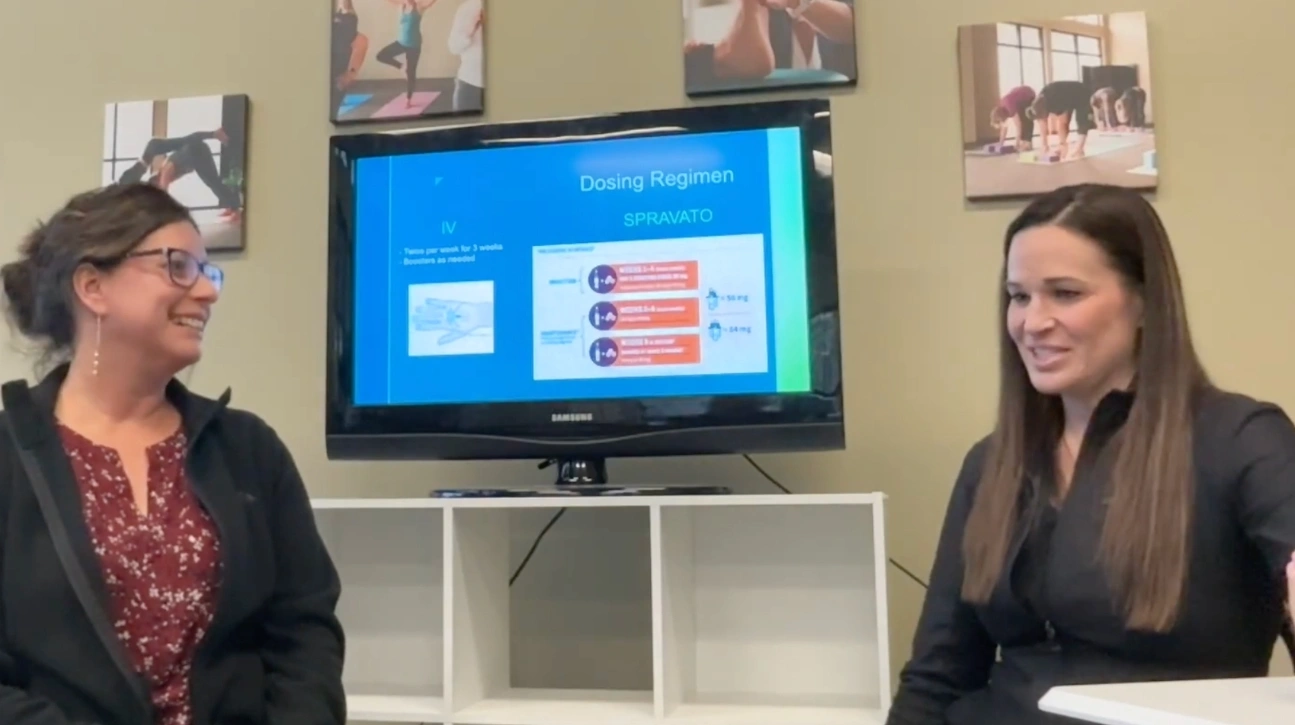
Beth Westermann: So the biggest difference between the two there’s a couple really big differences. Ivketamine is a cash pay service. That is because it is not FDA approved as for mental health purposes. It’s only FDA approved as an anesthesia adjunct. So we do um we charge $400 per infusion. I will say I don’t know of any clinic that I’ve heard of across the country that charges less than that. That’s that’s kind of the lowest point that you’ll probably see it. Um so $400 per infusion and both IV and intraasal have an induction phase and a maintenance phase. So IV the induction phase is six doses over three weeks. You come in twice a week for three weeks. So if you’re considering starting IV ketamine, um one downside is that it is a cash pay service. It’s $2,400 upfront for that initial um induction phase and then you come back as often as you need to to maintain a decrease in your depressive symptoms. Most patients we have them come back like two to four weeks after they finish their induction phase. But with IV ketamine over time those patients are able to spread their doses out a lot more. So over time it does have the potential to become more cost effective. We’ve got patients that come in you know once every three to four months for their boosters, their quarterly boosters. So once you’ve been on it a while and and those nerve connections I talked about have had time to establish and all those things, you know, at the cellular level have had time to happen, then it can be more cost-effective. Um and and being able to space the treatments out more, that’s another perk of going IV. So you know, it is a time commitment to receive ketamine. Um the IV infusions, it’s a 45minute infusion. Um roughly anywhere from 40 to 60 minutes. We we tailor it to the patients and how they they respond to the treatment um and how much they can feel the ketamine. tailor their infusions and monitor them for 45 minutes afterwards. So, they’re about two-hour appointments. With the Spervado, um the induction phase is a 8week induction phase. You receive 12 doses over eight weeks. So, it’s twice a week for four weeks, then once a week for four weeks, and then you enter into maintenance. Now, the nice thing about Spato is it’s covered by insurance. So, um, and especially for commercial, uh, people with commercial insurance, they have something called the Sperbato with me savings program that takes the cost of the drug and cuts it down to a $10 co-pay. And this is a $1,000 drug that it costs us about $1,000 per dose. So, cutting it down to a $10 co-pay is is pretty incredible for those patients. And the nice thing is that that where it happens in the billing steps that the amount that they’re you know that um is getting counted towards their deductible happens before they come in and do that. So so patients because it’s such an expensive treatment it knocks down their deductible really quick and then that savings program comes in and just covers the cost. So the patients can knock their deductible and their out-of- pocket max down pretty quick without actually having to pay out of pocket for it because of that savings program. um Medicare and Medicaid patients don’t qualify for that savings program, but Medicare and Medicaid do cover the medication very well. And the nice thing about about um them as well is is they um they cover medical transport. So for patients that have to have a ride and have trouble finding someone to pick them up after their treatments and drive them home, they can’t afford an Uber. Yeah. They can have medical transport covered by Medicaid. So that is a really nice perk of that.
Natalie Johnston: Um I’m gonna jump in with a quick question. So, back to kind of how it works. Um, what is the long term? I mean, I’m not sure I’m throwing this question at you randomly, but um long-term studies or outcomes. So, do we have lasting neuroplasticity? Yes. With this?
Beth Westermann: Yes, it it definitely increases neuroplasticity. Um, and the data, I mean, they’ve been doing data on or they’ve been doing studies on this for for many years before it even got FDA approved. and and currently depending on the research study you read it it quotes about a 70 to 80% efficacy rate. So a very high efficacy rate with with very minimal side effects. Um most side effects and we’ll go over potential side effects. There are very few and most of them are resolved before they even leave the clinic if they have them at all. And we actually run data on our own patients pretty frequently. I think we’ve done it two or three times now um to see how we match up to what the evidence says we should be doing. And we have found that we’re actually closer to the 80% efficacy rate. We’re we’re on the higher end of that. So, we do see that research translate into our patients. We see excellent uh uh efficacy results from that.
Natalie Johnston: Yeah, that’s amazing.
Beth Westermann: Yeah, there are patients that are non-responders and we’re really big on being very transparent with our patients when they come in. We don’t sugarcoat anything. We don’t ever want to overpromise or underdel to these patients. So, we’re very transparent about about the efficacy rate and and that some patients are non-responders, but we always encourage patients give it the full induction phase before you make that choice because every patient starts to feel better at different times. Some patients feel remarkably better after their first dose, but that’s pretty rare. Most patients it it takes longer before they start feeling it. But in contrast to traditional anti-depressants that, you know, a lot of them have like a 40 or 45% efficacy rate. you have to take them for 80 or for eight weeks before you even know if it’s going to help. This is a much better option for them. You know, it works faster if it’s going to work. Um, and has a much higher efficacy rate than a lot of traditional anti-depressants that come with a lot of side effects.
Natalie Johnston: Yeah. So, it’s a it’s a really amazing treatment option um compared to to some of those medications that can have a lot of debilitating side effects to them. Yeah. Wow.
Beth Westermann: Yeah. So, that’s um just kind of a quick overview of the treatment regimen, the the time commitment. It is a decent time commitment. Um, with Spervado, the FDA does require that we monitor patients for two hours. So, it’s a self-administered medication. You puff it into your own nose. Um, we just hand the patient the device, they puff it in their own nose, and then from the very first puff, a two-hour timer starts. So, you’re with us for a long time. And we’ve done a lot of things to make our treatment rooms as comfortable as possible. We’ve got big fluffy lazy boy chairs. We’ve got coloring books and headphones. And we have aroma therapy. We have noise machines. We have like star machines that put stars on the ceiling and different colored lighting. We have come out. Yes. Yes. Foam chargers. Like we have hard candies on the table because we’ve heard that the spervado does not taste very good. So patients suck on their hard candies and not safe for them to do when Yeah. Yep. Yep. So we have a lot of things we’ve done. You know, in the ketamine world, there’s a buzz term called set and setting. And it’s your mindset you’re in when you receive the treatment and the setting you receive it in. and and we kind of we consider we’re in charge of the setting and so we want to make the setting as peaceful and relaxing for these patients as possible. And then we we try to help coach them or encourage them to work with their therapists um on mindset like okay finding ways to come in with a proper mindset beforehand, a positive mindset because whatever mindset you come in with does play a role in your lived experience during your treatment. So, we really encourage patients to talk with their therapist about different ways they can work on getting into a good mindset before they come into their treatments.
Natalie Johnston: And I feel like this is maybe a silly question, but I feel like I might not be the only one asking this question. Um, when you say lived experience and mindset, what is happening during a treatment?
Beth Westermann: Yeah, I have a whole slide devoted. Okay. So, I will let you know. Yeah. One cool thing too that we offer to patients, we actually had a company just cold call us. Basically, they just sent me a packet of info in the mail. Um, and they’re called Limitless Guided Visualizations. And it was actually, and I might get the details wrong. I I don’t remember if she was a psychiatrist, psych, psychologist. It was a mental health provider who actually created the app. She had received ketamine for herself. I have heard of this. Yes. So, she had received ketamine for depression herself and she she realized that there is nothing out there um for patients to help them stay in the right mindset. Like the most common thing our patients would do would like go on YouTube and watch a video with binaural beats and just listen to that spa music, the binaural beats. And and once we introduced Limitless, we partnered with them. Um we have a QR code patients can try it before they buy it. And and they’re she she developed 12 different she calls them macro doses. They’re 90-minute episodes. The patients, it’s all on mindfulness. And she developed them around Maslo’s hierarchy of needs. So, there’s one called I am enough, I am safe, I am worthy. There’s different episodes and they’re 90 minutes. So, they’re designed to be listened to during your spado treatment. And then they have micro doses as well that are like 15 to 20 minutes and it’s to practice mindfulness at home. And then they have chill music channels as well. So, we have a QR code. Patients download the app. It gets them like a like a free version and if they try it and they like it, we have um codes to get them a free year. It’s usually about $70 for a one-year license. So, we’ll give them a free year of that and patients love that. It really helps to keep them in a good mindset and ground them during their treatments and and makes it more of a a relaxed experience for them.
Natalie Johnston: I mean, it makes sense to pair that with the treatment. And there’s, you know, there’s all sorts of other mindfulness-based strategies that could be paired, but it sounds like this is a structured program that can be paired, which is perfect.
Beth Westermann: Yep. And they actually they only had, I think, nine episodes or nine macro doses, and then when we partnered with them, we told them, well, we primarily offer Spado, which is a 12 dose induction phase. So, they recorded three more episodes for us. And so, now there’s a 12 dose menu to get them through that induction phase of the Spado. Yeah, it’s a really cool app. So, um these are you’re not going to be able to read. I’ll read them aloud, but these are the important ones. So, these next two slides are the eligibility requirements. So, this is one slide I really wanted to include so that um any listeners could know what patients will actually qualify. Now, these are the eligibility requirements for spado. So, these are what the FDA says a patient has to meet these requirements in order to receive treatment. We take these exact same guidelines and apply them to our IV ketamine patients as well, but we do have some wiggle room. Like they don’t quite have to prove treatment resistance as much. The way we look at it is if their mental health provider would like them to try ketamine, they think it’s a good option for them or the patient would like to try it and the mental health provider or their referring provider, be it their primary care provider, um if they would like to try IV ketamine, they can refer them to us. As long as we have that referral and they have major depressive disorder, we don’t necessarily make our IV patients meet all the requirements for treatment resistance. We our hope and and Spado’s hope, Johnson and Johnson’s hope is that Spado will get approved as a first-line treatment. They prove treatment resistance. Like why do we have to prove treatment resistance? That’s how it was studied. This is superior. So it was studied only in treatment resistance and it was also studied taken with a a conccomittent anti-depressant. So when they first released it, when we first opened, patients had to take an anti-depressant and spato. They couldn’t receive spato unless they were taking an anti-depressant. But they did enough studies and proved that because but and that’s just because that’s how it was studied. They didn’t make patients quit their anti-depressant before starting the spado for the study. They let them stay on one or at least one. So that’s how it was FDA approved. They’ve since done enough studies, they dropped that requirement a year ago, last January. So um they no longer have to take an anti-depressant with it. And we know that there are ongoing studies um head-to-head studies with other traditional anti-depressants in an attempt to have it approved as a first-line treatment. So, we know that’s on the horizon. We’re not allowed to know any details on that from the Spado reps or anything because I don’t think they are even allowed to know. Um but it’s something that we know is coming and we like we cannot wait for that day because we’ve seen in our own clinic how much this changes people’s lives. every single day, right? I come in and patients tell us the most amazing stories um of how it’s changed their life and and yeah, if this could be a firstline treatment, it would change the mental health space for sure. Wow. Yeah. So, um the first eligibility requirement, patients have to be under the care of a psychiatrist or psych mental health nurse practitioner. Um, we did notice that once PAs, um, I think it was last legislative session or the one before, um, once PAs gained the right to be independent providers in Iowa, we noticed that our insurance carriers did start accepting PA or or referrals from PAs. They were approving authorizations if the referral came from a psych PA. So, um, I would add that to that list, but it has to be a psychiatrist, psych nurse practitioner, or a psych PA that refers the patients to us. Um, one thing we’re really big on is we do not take on any of the patients mental health care. We are not mental health providers. We practice within our scope of practice. We make that very clear to our referring providers that they are in control of everything that has to do with the patient’s treatment regimen. We simply provide a consultative service and offer the ketamine, keep the patients safe while they receive it, and return them back to their mental health provider. So, we we actually educate our staff. We are not trained therapists. We are not trained mental health providers. It’s not our job to offer advice. It’s not our job to therapize the patients when they’re in our clinic. We listen and then we say, “Would you like us to reach out to your therapist or your mental health provider on your behalf to make that connection to to if you need further help?” We we are very strict on that overstepping that boundary. Um, for proving treatment resistance, patients have to have tried and had an inadequate response to at least two different anti-depressants from two different drug classes. I I haven’t fact checked it yet, but I’ve heard that they got rid of the requirement for it being from two different classes. It just had to be two anti-depressants, but don’t quote me on that. I haven’t fact checked that yet. I just heard that last week. Um, and then each of those has to have been used for at least eight weeks. And then in addition to that, the patients have to have tried and had an inadequate response to what the insurance companies call a drug augmentation trial. That can either be two anti-depressants from two different drug classes used simultaneously for at least eight weeks or it can be an an anti-depressant and an antiscychotic and anti-depressant lithium um anti-depressant and thyroid med. There’s a bunch of different combinations. Each insurance companies can be a little different in what they accept as an augmentation trial. But those are what the patients have those are the boxes they have to check to prove treatment resistance for the insurance companies to approve treatment. Um should be currently undergoing psychotherapy or counseling on a regular basis. We always highlight that with our patients have to have a diagnosis of major depressive disorder. Um dysiaia does not count and then bipolar can be present but if there’s no diagnosis of MDD insurance will usually not approve the authorization. That’s a question we get a lot. Um if bipolar is the only uh diagnosis it will not get approved. Um that is because there is concern for the potential for ketamine to worsen mania. So, if we have patients that we know have a history of bipolar um or like any sort of concern for mania, we do extra counseling with those patients and just say, “Hey, keep us posted. Communicate with us. If you start to feel like you are feeling manic more often or manic at all and you don’t typically feel that way, we educate them that ketamine could potentially make this worse. So, keep us posted.” And um we have had that before. Not a ton. It’s very rare that we’ve experienced it, but the one or two times we have um had patients that have had worsening mania, we have open communication with their referring providers, let them know what’s going on, and we work together to decide if it’s safe for the patient to continue. So, we really rely heavily on their mental health providers to work collaboratively with us to make choices for their care.
Beth Westermann: Um, next slide. Oh, yeah. There there used to be 12. Um, and my numbering got a little messed up there, but uh, you cannot use any illegal or illicit substances. Um, cannot have an alcohol or substance abuse addiction. Patients that have a history of substance abuse, absolutely fine to come receive treatment. We just have to have documentation of a substance abuse um, uh, like a sobriety plan. We just have to have documentation that they have a sobriety plan that is being monitored by their mental health provider, okay, in some way. So, we just need to know that they are sober. We have had patients that we’ve had to work with them with their provider if they’ve shown up to, you know, appointments under the influence of something. You know, we we work with the providers on that. But our goal is to get as many patients having access to this treatment as possible. So, if there’s a way to get a patient into a sobriety program, we work with their mental health provider to do that and then we we get them in as soon as we can. Um, a big question we get a lot is uh THC, people that use that have a medical card or that use recreationally. um our stance on that and and the stance of of Spado as well. We just ask that patients not use any THC within like on the day of their treatment within 24 hours after they finish their treatment. The way I describe it is I want to be the only one in charge of your mental status. I don’t want any other substances affecting your mental status because I need to be able to keep patients safe when they’re receiving the ketamine. So, I don’t need anything else clouding their mental status. Um and so we that is something that we just we make sure that the patients know you cannot use any THC on your day of treatment and try to go 24 hours afterwards um before you use any of that. Um contraindications there really are very few absolute contraindications for receiving treatment and they all have to do with blood pressure. So ketamine can spike your blood pressure during your treatment. It can jump by 10 20 points during your treatment. It usually peaks around the 40 minute mark. Um but because it can cause an increase in blood pressure, any patients that have a history of um aneurysmal disease, a thoracic aneurysm, a a um abdominal aneurysm, cerebral aneurysm, an an AVM, an arterial venus malf for any history of intra cerebral hemorrhage, um or any history of uncontrolled high blood pressure. Those are the patients that it’s an absolute contraindication. They cannot receive treatment. So we just don’t want to risk causing any sort of bleed for those patients. um you can’t be pregnant or breastfeeding. Um we do know that ketamine is vetoxic. We do know that ketamine appears in breast milk. So um we we offer for patients to take a pregnancy test every treatment if they’d like or they have the option to sign a pregnancy liability waiver if they don’t want to do that. Um for spado patients have to be 18 or older. That’s all it’s FDA approved for. But with IV ketamine we go down as as young as 14 years old.
Natalie Johnston: I was going to ask about that. Yes.
Beth Westermann: And we’ve seen really great results in our teenage patients or college patients. Um yeah, so we we do take down to 14 for IV ketamine. Okay. Um and parents are able to stay with them if they like. Sometimes patients like to be in there by themselves to experience it on their own. It’s completely up to the patient. They don’t have to have someone that stays with them. Um they just have to have a driver afterwards. Um and that’s what this last one is that you have to make your appointments and bring a driver with you because you are not safe to drive after you receive ketamine. They’ve actually studied it and they found that even patients that think they’re totally back to normal. They test their reaction time, their critical thinking, and they’re still very delayed. So, to keep them safe and keep other people on the road safe, then you are not allowed to drive until you’ve had a good night’s rest.
Beth Westermann: Um, side effect, we kind of touched on the blood pressure. You could have a transient increase in your blood pressure. Keyword transient, it’s patients are typically back to baseline before they walk out the door. Nausea, um, I would say around maybe 25% of our patients um we have uh Zopran or Andanatron. It’s an anti-nausea medicine. We have the kind that dissolves under your tongue. So if a patient experiences nausea or is sensitive to motion sickness or anything like that, um we can pre-treat with Zopran beforehand. Just give them a little tablet and they melt it under their tongue. Um and then with IV patients, every IV patient gets a dose of Zopran before they start their treatment just because we have an IV already. We like to ward off those evil spirits. So nausea I would say is the most common um side effect that we see. Um patients are not supposed to eat or drink before they come in for their appointments. But um we do have some patients that have said you know actually having an empty stomach is what makes me feel nauseous. The spervado doesn’t taste very good or it makes them dizzy and then they feel nauseous from that. So we have meds we can give to help with dizziness. Um the little hard candy that’s the little hard candies help with that. So there’s different tips and tricks that we have to help patients with that. Um, and then sedation and dissociation, which was the question that you asked earlier. That’s this slide. And this is one of the biggest questions we get is what am I going to feel like when I’m on ketamine? You know, patients know it’s a psychedelic, it’s a psychoactive medication. They know they could feel some sort of way. Um, so the two biggest things is sedation and then dissociation. So sedation, it’s very common for patients to get tired when they receive ketamine. Um, we do not allow patients to sleep during their treatment because they found that if you sleep during your treatment, it can decrease the efficacy of the ketamine, but sleeping after your treatment, getting that good night’s sleep that I talked about. Um, that is encouraged because that’s when all those changes are happening in your brain. So, we really encourage good sleep after your treatment. Um, but dissociation is the thing that patients are that’s what they’re most curious about. Am I going to get high? Am I going to dissociate? You know, am I going to ride the K train? all the different buzz terms there are going down the khole. You know, there’s all different ways that patients word it. Some are more positive than others. I always say the blanket statement at the beginning when I’m talking to patients about this is that it is extremely extremely rare in our clinic setting. I mean, I can probably count on one hand in over 15,000 treatments we’ve done that a patient has had a negative, scary, fearful experience. It’s very rare and and we have such a titrate like the ability to titrate the dose on the medication that we can really avoid that happening. We can slow their IV infusion down and that helps them to feel better within 30 seconds. So, we have a lot of things that we can do. But when I say dissociation, there’s a couple different things like there’s a lot of different ways and these are all I pulled this list from things patients have said to me of how they feel. I’ve never tried ketamine, but um this is how patients describe how they feel. You can feel like you have an outof body experience or a depersonalization or derealization. That’s kind of what dissociation means, like a separation from your core self. Some patients experience that like they’re having an out-of- body experience. I had one patient that said she felt like her head was floating on a balloon string and she was just watching herself just floating above herself and she loved it. It happened every time and she loved it. Uh but it’s really that that depersonalization, that out-of- body experience. That’s how patients very often tell me that’s how their healing that’s where their healing comes from because they’re like, I finally can feel like I step outside of my body and I view my depression as an entity separate from myself and it’s something I can put in a box and then it’s more manageable. It’s more like I feel like it’s something I can tackle, something I can treat and it’s not something that just overwhelms and consumes me. It it makes it something more manageable. And that we hear that a lot from patients that that is often times where their healing comes from is having that separation and being able to view it as something that is manageable. Um a floating sensation patients can feel like they’re floating or the opposite they can feel like they’re melting like they’re sinking into their chair. I had one patient that called it melty face. Like I they they you get three devices spaced five minutes apart and it was always after her second device she’d be like, “Yep, melty face is setting in.” And and that’s just how she described it. Um, you can have alterations in your senses. Um, and that really I’ I’ve never had a patient say they smelled something that wasn’t there, but some patients have had visual hallucinations. Those are very rare. Um, but in all the patients I can think of that have had a visual hallucination, it’s always been a very curious experience. It’s never been a scary experience or or any sort of unwelcome experience. It’s always been more of a source of fascination and curiosity for them. Um, but that’s one reason that we encourage patients to be in a good mindset when you come in because that’s that lived experience I was talking about. If you come in and you’re in a negative mindset and you’re really angry or you’re unhappy and you know you’ve got some road rage and you’re coming and carrying that, that can affect how you experience dissociation and it could lead it to a more negative pathway. So, we really try to sometimes we’ll just let them sit like why don’t you just watch a funny, you know, YouTube video or listen to some peaceful music that makes you happy. just take 10 minutes to yourself and then we’ll start your treatment. And I actually have canceled treatments on patients that have come in super hot and come in just really not in a good space. I sit down and talk to them. I’m like, I really don’t think it’s a good idea for you to have treatment today. I do not want to put you in a position where you’re going to have a negative experience and then not want to come back. So, I have canceled patients before when they’ve come in in a very, very bad mindset. But, it’s I’ve only done that one time. Um, you can feel dizzy or drunk. That’s very, very common. patients on their first treatment when they’ve never experienced it, they’re like, I just feel like I’m drunk. Um, and if patients are dizzy, we have a medication called mechloine that we can give a little chewable tablet. It’s kind of like Dramamine or Scopalamine for motion sickness. So, we we give meine for that. Um, patients that have have uh trouble with dizziness on the drive home when they’re in a car, we can give them a mechazine at the end of their treatment and they can take that before they go home and it helps keep that nausea at bay when they’re in the car afterwards. Um, they can feel calm and peaceful. That’s also very common. Um, like I had a patient once explain or describe his treatment is he’s like, “It’s like a commercial break from my life. My life out there, my depression is so heavy. Life is so hard, but I come in here and it’s my 2-hour commercial break from my life and it’s just my time to be calm and peaceful and and I loved that mental imagery.” Yeah. Um, it can open doors and filters can disappear in your mind. I warn every patient about this because I’ve seen it with my own two eyes. Most common way this manifests is patients say, “I just I want to cry, but I just can’t. Like, I’m not able to cry, and I really wish I could.” That patient might be sitting in that recliner just sobbing for a half hour. And they’re like, and it’s once again, it’s very, very rare that it’s a negative experience. Those patients will say, “That was so cathartic to finally be able to cry and finally let it out. It felt so good.” So, I just warned and I we’ve had patients, too, that that have like You know, with depression, you can have memory issues and have memory loss, both short and long term. And there’s patients that have been like, I got some of my memories back. Those filters just dissolve in my mind and I remember things from my childhood or from my early adulthood that I don’t I didn’t remember before. But the reason that I put this in the slides and I tell every patient about this is because if you have past trauma, you know, there’s no way for the ketamine to know what filter to dissolve and what memory to bring back. So, I warn patients about that. But it’s that is something I can think of one example where a patient remembered a past trauma that their brain had totally blocked out and they hadn’t remembered and then they remembered it and we just talked through it and worked it worked through it and she worked through it with her her mental health provider after the fact and and it turned out okay. But I just I like to once again be transparent with patients so they know what to expect. And then just the last one says that it peaks around 40 minutes. So with that two-hour appointment, usually it’s peaking around 40 minutes. The FDA requires that we do a blood pressure or vital sign check at the 40-minute point. And that is why because your blood pressure is going to be peaking around that point. Your dissociation’s going to be peaking around that point. So, we’re laying eyes on on the patients and checking in on them. We do intentionally try to leave them for that space between when they start their treatment and the 40-minute mark because that’s kind of the high yield part of their treatment when they’re dissociating most heavily. And we don’t want to ground them to reality because that’s where a lot of that healing happens. So, we intentionally leave patients unless they ask us to come and check in on them. And we keep track of patients preferences um all their preferences. I mean, any patient that walks in, I know they like the purple light, they want stars on, they want lavender aroma therapy, and they want a set of headphones next to their chair. We track that for all of our patients and have their room set up to their specific designations every time. Um and then I think this might be my last slide. On the treatment day, on the day of treatment, um we do ask patients for spado. They say two hours NPO or not eating or drinking anything. IV we say six hours. Um we the way that we track patients and their progress is um we Beck’s depression inventory or a BDI. We send a BDI out to every single patient before their treatment. So they fill out a BDI every single day um that they have a treatment scheduled. Not every day of the week, just on the days they have treatment scheduled. Um, so they fill that out and that’s how we track their progress and and we have the BDIs integrated in our electronic health records so we can print out like the graph of how their BDI graphing progress or change over time.
Natalie Johnston: Yeah. And some patients say, “Don’t ever show me. I don’t want to know because I’ll hyperfocus on it.” And other patients are like, “Give me my next print out. I put it on my fridge so I can like be so proud of myself for my progress.”
Beth Westermann: And we send screenshots of that graph. um when we we do quarterly updates for their mental health providers who refer them, we send updates so we can increase that that communication and work collaboratively with our referring providers and we send screenshots of that graph so they can see their BDI progression over time and how well the spot has worked for them. So um and we also have to have that number. Some insurance providers require a certain percentage of decrease in a depression rating scale to approve continuing authorization. So, we also use those number numbers to keep patients um authorized by their insurance companies. Um we already talked about being monitored for two hours. We’re checking the vital signs regularly and must have a driver. And the last thing I have on here is just that this is meant to be a long-term regimen. That’s a question patients have a lot like, do I just do it short term and then I’m cured? Um and the way we describe it is it’s it’s kind of like a blood pressure medicine. You might reach a point in your life where you have to start a blood pressure medicine. you have the ability to make lifestyle modifications, exercise, eat healthy, and you might be able to get off that blood pressure medicine. But some patients are just on it for the rest of their life. And that’s how we describe spato. Like the spado could the spat itself does not fix the depression. It’s a tool that helps work symbiotically with the other puzzle pieces in their mental health regimen, right? like their therapy, their their other anti-depressants that they take them, their you know their like their whole treatment regimen as a whole. Spado is just one puzzle piece. But what we have found through patient feedback is that that Sprovado puzzle piece allows them to use the other puzzle pieces easier. So I I’ve had patients tell me so many times like my therapist has been working with me for years on these these tools and these coping mechanisms and all these things and I just never could use them. But since I started Spervado, I can finally use those tools and and and it’s helped them to be able to heal because they’re finally able to use those other tools almost something to bridge that gap between I’ve got the information but I’m not able to enact it. And
Natalie Johnston: well, I like what you said about long-term regiment because there there are so many of those lifesty lifestyle factors that we know um we have plenty of research to show make a difference. good sleep, nutrition, healthy immunity, avoiding risky substances, exercise, right? We know that stress mitigation, we know that these are things that um prevent disease and promote healing and one person’s ability uh for various reasons to adhere to those lifestyle factors will differ from another person. And so having this as another tool in your tool box in combination with those lifestyle factors um there there’s probably a continuum of of progress that from hey this is really great to and my treatments are are spread apart to I’m not adhering to these other lifestyle factors for for various reasons. Um and so my treatments are going to have to stay pretty regular.
Beth Westermann: Yeah. And we see that and that’s you know I mentioned that with IV ketamine one perk of IV is that those patients can spread their doses out a lot more typically with spervado they end their induction phase coming in once a week. I’ve really found with those patients specifically they’ve been they were coming in twice a week then once a week by the end of their induction phase they know it’s working and these are patients once again they’re treatment resistant. And so by the time they come to us, they’ve tried everything. And this is a lot of patients, they they will say, “This is my last hope.” And so when they finally found something that’s working for them, they’re so scared to mess with it in any way. They’re like, “It’s finally working. I just don’t even want to look at it.” And so we find spado patients stay on the once a week regimen for a pretty long time before they finally get to the point that they feel like they’ve stabilized and they’re like, “Okay, now I want to try and space it out a little more.” So when I say it’s a big time commitment, I mean it. It’s two hours once a week. But those patients, they we eventually will spread them out. Um when we first open, if they were ready to space them out, we we instead of coming in once a week, we’d come in every other week. We quickly found like because that’s what actually was recommended by the FDA and by Spado. We found that did not work well. Going from once a week to once every two weeks, that’s a huge jump. So we found that easing patients into it, we start them out with a 10day spread. So we say instead of four times in a month, come in three times in a month. 10 days. If you can swing it, sometimes if Thursday is the only day they can get a treatment, they can’t do that then. But we encourage a 10day spread. And if they can make it a month at a 10day spread, then we try every other week. And those patients are typically a lot more successful when we ease them into it like that. So we just we just discovered that through trial and error and it works a lot better. But we’ve got patients that have been with us for years from when we opened in 2022 and those like we’ve had patients graduate know they’ll space out to two weeks and then they’ll try three weeks and then they’ll come in once a month and eventually say I think I’m going to just take a break from it and and most of those patients we have never seen them come back. So there is the potential to heal. There is the potential to reach remission. there is the potential to be able to stop spread, but every patient’s different, right? And there’s no way for us to know, right, which patient is uh gonna do what. So, we just work with them um based on once again what the evidence says and what our our own clinical experience has shown us.
Natalie Johnston: Yeah. So, that’s amazing. We do have a mental health provider here. Do you have any questions that you want to ask? I think you answered everything. There’s a lot of information. A lot of information. I have a lot of questions, but I’ll save those. I’ll save a few of them. Um, yeah. I I think we’ll we’ll save them for another discussion, but I I feel like this was amazing. I learned so much.
Beth Westermann: I was hoping it’d be a good quick overview for people that don’t know anything about ketamine for mental health. Just like the most important highlights that easy to digest.
Natalie Johnston: I want everybody to know about this.
Beth Westermann: So do we. I mean, that was that was a huge part of our mission when we opened up was we wanted to increase access to care. That was our our number one goal of opening our clinic is increasing access to one of the most struggling populations in healthcare. There’s never enough mental health options out there and we wanted to be able to have a place where patients could receive Spado, not have to worry about the financial implications of it or receive IV ketamine if that was something that was financially feasible. And and we always try to work with our patients. They we have the option to set up payment plans. you know, our we have an insurance billing specialist named Darlene who is just we couldn’t function without her. She’s incredible and she is wonderful with working on working with patients and and telling them ahead of time this is what you can expect the treatment to cost and and all of that. So the patients are really well prepared before they even start treatment.
Natalie Johnston: Yeah, that’s amazing. Thank you. Thank you so much.